Airline Operations Simulator · Digital Twin
Every slot, delay, and diversion — modeled to the tick.
AeroTwin is a deterministic airline operations simulator: a digital twin of an airline's operations center. Schedules, weather, irregular operations, cost — direct the whole operation, reproducible to the cent.
What it is · Ops control center
A simulation only worth running if it's honest.
The closer the twin gets to a real operations center, the more its decisions — and their costs — actually mean something.
Run the operation.
A serious airline-operations simulation, not a tycoon game. Schedules and slots, aircraft and cost, weather that turns. Irregular operations arrive without warning, and you make the cancel, delay, and recovery calls a real ops controller lives with.
Nothing hand-waved underneath.
Underneath: A-CDM milestone timing, crew duty limits, stand constraints, individual passengers, integer-cent money. The same mechanics a real ops center runs on — reproducible to the cent, replayable from the command log.
See it run · The ops console
The operation, not a spreadsheet.
One deterministic twin — a month of a real carrier's published timetable — read from every desk in the ops center: the rotation, the network, the board. Same console, native or in the browser.
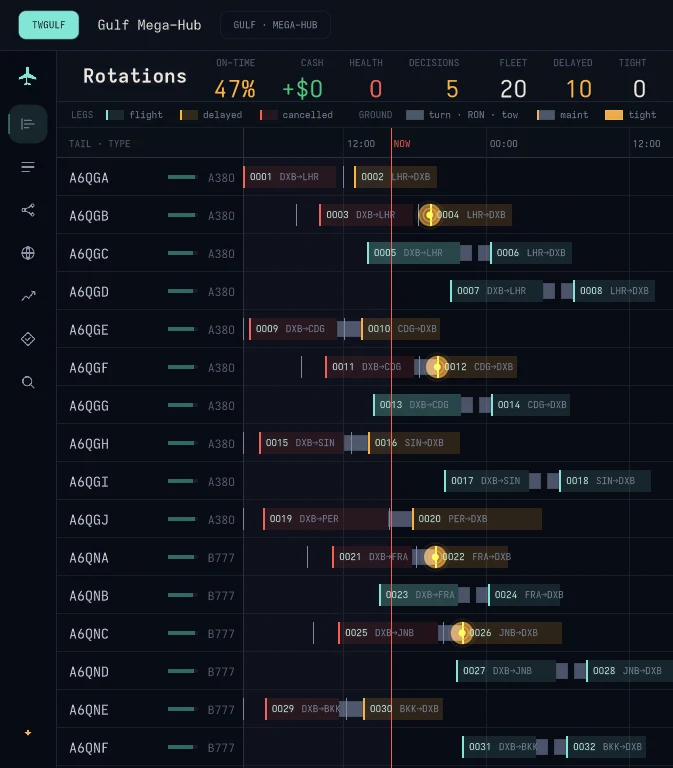
Every tail's day on one timeline — turnarounds, tight connections, and a delay rippling down the rotation, tick by tick.
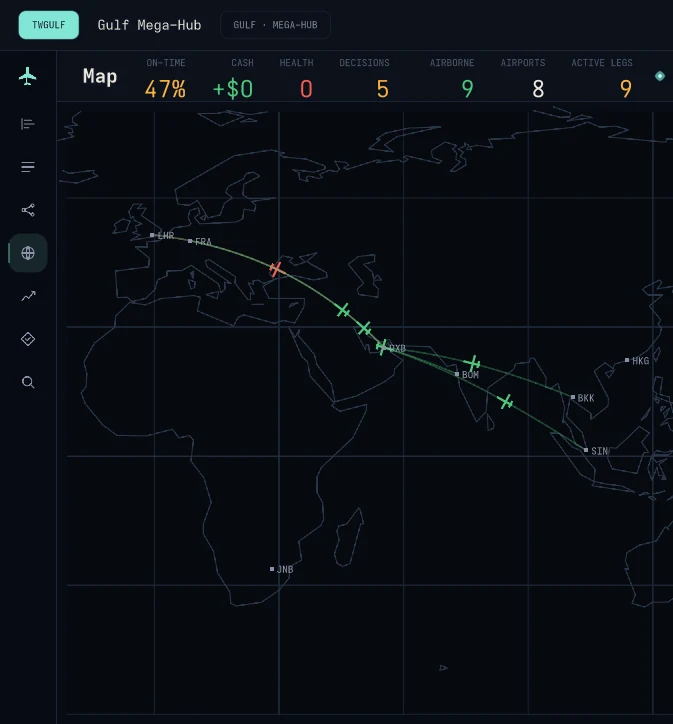
The whole operation in the air at once — on-time, minor, and major delay, live.
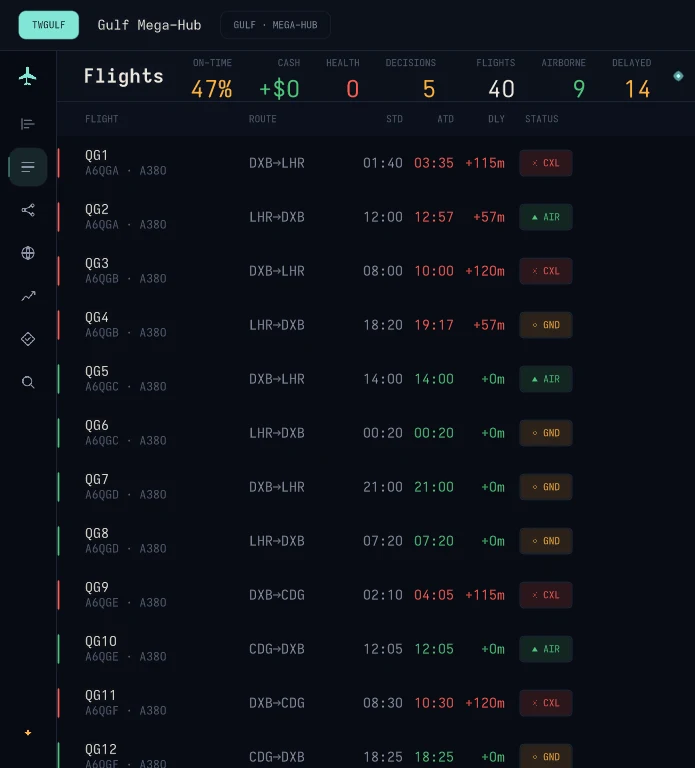
Scheduled against actual, to the minute — the board a controller reads.
Deterministic replay · What-if
Replayable isn't a technicality. It's the whole point.
Run the same storm twice and the second run is identical — so when the outcome changes, it was your call that changed it, not the dice. That exact counterfactual is the one thing a real ops center never gets.
The snowstorm that paralyzed the hub — the same weather, the same schedule, waiting for you. Try your recovery, watch it cascade, rewind, and take a different call. As many times as it takes.
Post-mortem the cancel-versus-divert decision against identical conditions every run, and read the cost of each path to the cent. A sandbox where the what-if is reproducible, not an anecdote.
Domain fidelity · A-CDM & IRROPS
It speaks the operation's language.
Not a weather-and-money abstraction wearing airline paint. Breadth is the easy axis — anyone can count airports. This model goes the other way: the crew's duty limits, the stand the aircraft can't have, and every individual passenger sitting on it.
- A-CDM milestone timing and codeshare designators, with IATA-coded delay causes
- Aircraft rotations — minimum ground time, and knock-on delay down the tail
- Crew under configurable, ICAO-generic FTL — duty tables, cumulative limits, augmentation
- Stands by capability and adjacency, airport capacity and curfew — including the delay a scarce stand causes
- Maintenance and AOG, diversions and ground returns, ATFM slots and holding — down to offloading cargo for weight
- Individual passengers — fare, loyalty tier and bags, re-accommodated one by one
- Booking curve, no-show, overbooking and standby, on real origin–destination demand
- Projected out as A-CDM, AIDX, SSIM, FIXM, MVT, OOOI and BTS
- Reading IATA SSIM — today the schedule is projected out as SSIM, not ingested from it
- Adverse-weather scenarios from historical METAR / TAF
- SID / STAR and airspace constraints
- BADA-grade performance — today it is a range-and-payload envelope
- Fuel price, and LCC-vs-FSC P&L
Each one lands the way the left-hand column did — as a model with consequences, not a label on a page.
How it holds up
Built on a backbone that doesn't drift.
Deterministic core
Same seed, same command log, same world — down to the last cent. Every run is replayable and auditable, not a one-off you can never reproduce.
Irregular operations
Weather, technical failures, crew timeouts and ATFM slots arrive from a seeded stream — disruptive but reproducible. They cascade down the rotation and through the cost line exactly as they would in a real operation.
Open core
The simulation engine is open source — the repository opens with the public launch. Inspect the model, run it headless with nothing but cargo test, and write plugins against a semver-stable ABI.
Language models in the loop
Frontier models, wired into the operation.
Not a chatbot bolted to the side. Language models drive the parts of an operation that are messy, human, and never the same twice — so the pressure on the desk feels real.
Snags & comms
Pilot-reported snags and virtual-ATC exchanges, written in the voice of the moment — the ambiguous, incomplete inputs a controller actually has to act on.
Passenger fallout
When a bank collapses, models read passenger sentiment and weigh rebooking cost against the clock — so an IRROPS call carries its human and financial weight.
Your choice of model
Bring the frontier model you trust — plug it into the loop and see how it holds up under an operation that doesn't wait.
FAQ · Airline ops simulator
The questions before the first tick.
What is an airline operations digital twin?
A running model of an airline's operations center — its schedule, aircraft, weather and costs — kept close enough to the real thing that a decision taken in the twin behaves the way it would on the real desk. AeroTwin is one you operate rather than observe.
Is AeroTwin a game or a professional tool?
Two ends of one model. The surface is a serious airline-operations simulation — an ops-controller's desk rather than an airline tycoon game. Underneath is a real engine: A-CDM flight timing, a seeded weather stream, integer-cent money.
What does deterministic mean here?
Same seed and same command log produce the same world, down to the last cent. Every run replays exactly, so a what-if is reproducible instead of anecdotal — and the final world is hash-checked on every build.
How does it model irregular operations (IRROPS)?
Weather, delays and cancellations arrive from a seeded stream rather than a script — unpredictable in the moment, identical on replay. Disruption cascades down each aircraft's rotation, and the cancel, delay, divert and recovery calls each carry their cost.
Is the simulation engine open source?
The deterministic engine is open source, written in Rust: read the model, run it headless with nothing but cargo test, and write plugins against a semver-stable ABI. The repository opens with the public launch.
Does the console run in the browser?
Yes — the same console runs in the browser and as a native app, reading one deterministic twin either way. Nothing to install to look around.
Can I plug in my own language model?
Yes. Language models drive the parts of an operation that are messy and never the same twice — pilot-reported snags, virtual-ATC exchanges, passenger fallout — and you bring the frontier model you trust: GPT, Claude, Gemini or Grok.
When can I try it?
We are building in public. Join the waitlist for first access, the dev log, and the opening set of operation templates.
The backbone, in spec
Determinism, spelled out.
tick: u64
producer, tick)
replay
Early access
Take the desk when it opens.
We're building in public. Join the waitlist for first access, the dev log, and the opening set of operation templates.
NO SPAM · DEV LOG + LAUNCH ONLY · UNSUBSCRIBE ANYTIME